- Resources for Professionals
- My Way Cards
- Membership:
FIVE BENEFITS - DNR-Registry Medallion
- DNR Medallion for Natural Dying
- Our "ironclad strategy"
- Audios / Videos
- Advance Care Planning for Natural Dying
- Articles on End of Life Planning The Sooner Mother Dies the Better Palliative Sedation: Pros and Cons
- Surveys
- Testimonials
- www.ThirstControl.com
- Free phone consultation
What is Natural Dying?
by Stanley A. Terman, Ph.D., M.D.
What are the obstacles to attaining a Peaceful Transition?
Download an evaluation copy of Advance Care Planning forms for Natural Dying
What three steps should you take?
Why Authorize Your Proxy/Agent Immediately? PDF
Criteria of Advanced Dementia to Consider Natural Dying
“The Sooner Mother Dies, The Better” PDF (A story you should read)
Palliative Sedation: Pros and Cons
What is Natural Dying?
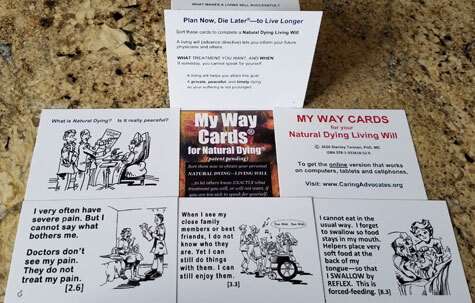
Natural Dying, like Natural Child Birth, does not depend on high tech medicine, and it requires even less skilled assistance for Nature to takes its course. When our brains can neither understand how to eat nor appreciate food, Natural Dying lets three things occur:- Cease Manual Assistance with Oral Feeding (as ultimately provided by skilled personnel),
- Withhold/withdraw all life-sustaining treatment, and
- Provide the best possible Comfort Care for a peaceful transition.
What are the obstacles to attaining a Peaceful Transition?
Even though the time might be right for you to attain a peaceful transition via Natural Dying, some individuals and groups may oppose your wishes. That's when you need carefully crafted forms to clearly and convincingly specifically state your wishes. Among those forms, the two most important are the Advance Directive to Permit Natural Dying and the Physician's Orders to Permit Natural Dying, which are combined on the same sheet of paper. (One is on one side and the other is on the other side.)
Why the combined form, Advance Directive to Permit Natural Dying and
Physician's Orders to Permit Natural Dying
is part of an "ironclad strategy" for Natural Dying.
Completing any Advance Directive requires diligence, however this is especially so with the Advance
Directive to Permit Natural Dying (AD-PND) and Physician's Orders to Permit Natural Dying (PO-PND). These forms represent a person's final wishes and orders. They will determine the final treatment received. In the past, these decisions have been the most contentious and prone to prolonged litigation. They are also the ones that affect loved ones most deeply.
Caring Advocates provides useable versions of these forms only to Certified Planning Professionals and physicians. Downloadable forms have a watermark with the words, "Evaluation Copy." The forms are part of an integrated strategic program that includes keeping the forms secure so they will not be implemented too early. Implementing the orders on these forms means the patient is ready to die, so they must be not only completed but also distributed with the upmost care.
Anyone who visits our Caring Advocates website can download an evaluation copy of the forms to Permit Natural Dying. Members of Caring Advocates can request a useable form, which has their Unique Identifying Number (UIN), be sent to their physician. They may also obtain the forms from the Caring Advocates Planning Professional with whom they discuss their wishes prior to visiting their physician.
What three steps should you take?
To decide and to consent to NATURAL DYING, we recommend three steps:- Download an evaluation copy of the Natural Dying forms so you can read and think about your options. You may also want to discuss these forms with others you trust, including perhaps, a Caring Advocates Planning Professional.
- Ask Caring Advocates to send a useable copy of the forms--one that has your Caring Advocates Unique Identifying Number (UIN)--to your physician so s/he receives it before your next office visit.
- At that office visit, discuss the Natural Dying forms with your physician and then consent, if you wish.
Click either of these two links to download the forms:
Physician's Orders to Permit Natural Dying (PO-PND Evaluation copy) PDF
Advance Directive to Permit Natural Dying (AD-PND Evaluation copy, which is combined with the PO-PND, above) PDF
(Note: Clicking on either form will download both.)
Criteria of Advanced Dementia to Consider Natural Dying
2. Expressing my wishes and promoting my pleasure and decreasing my pain: I cannot communicate any wishes by using words or gestures. I cannot make sounds or movements to indicate "Yes" or "No" in a consistent way. This incapacity puts me at risk to suffer from a variety of symptoms that others may not recognize and thus not treat, including physical pain and other kinds of suffering;
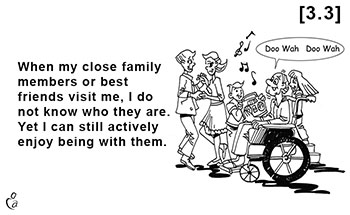
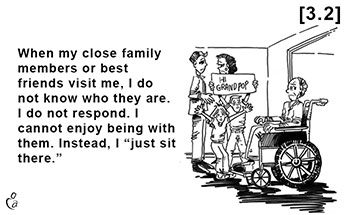
3. Relating to others: I cannot recognize family members or cherished friends. I seem puzzled or I am wrong in identifying them. I utter no words or sounds, or I make no gestures, as they enter or leave my presence. I am unable to pray to, or relate to a Supreme Being (if I believe in one);
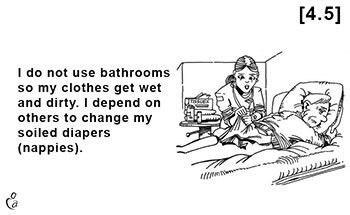
4. Dependency and Dignity: I have become totally dependent on others for my basic care; for example, I cannot bathe or dress myself, and/or I am incontinent of urine and/or feces. My social behavior no longer reflects my life-long values, so I have lost my dignity as I previously defined it;
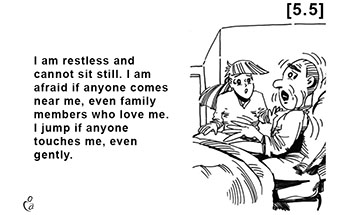
5. My mood, even with treatment: I rarely express joy or pleasure. I am almost always withdrawn, apathetic, despondent or non-responsive. I am often agitated or seem plagued with fear or horror;
6. Burdens versus effectiveness: Maintaining my existence requires almost constant care or intensive medical treatment, and will not be effective to provide improvement or to benefit to my quality of life so that I can live outside an institution or without such treatment or care;
7. Burdens versus benefits: I do not want to prolong the dying of my biologic body if I cannot appreciate any benefit while the burdens to my loved ones require great sacrifices, which may include: depleting my and/or their finances, diverting their attention from other important activities and responsibilities, and causing them to suffer from physical exhaustion or mental depression;
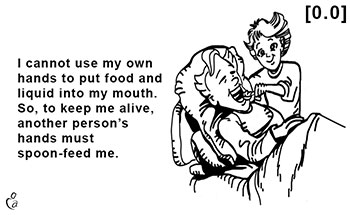
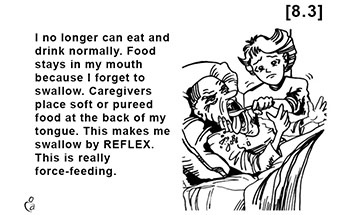
8. Regarding food and fluid: I do not want medically-administered nutrition and hydration, even if there is a risk of contracting pneumonia by aspirating into my lungs what others put into my mouth. After I have lost the mental ability to know how to eat and to drink, I do not want manual assistance IF I seem to have lost enjoyment from tasting and chewing so that it has become necessary to place pureed food at the back of my tongue to initiate a swallowing reflex, OR my actions indicate I am reluctant to eat, OR my trusted physician (AND my proxy, if authorized) believes that I meet a sufficient number of the other seven Criteria of Advanced Dementia to Consider Natural Dying.
© 2009 Stanley A. Terman, Ph.D., M.D. DrTerman@gmail.com
888-POLST-PND (888-765-7876)
Palliative Sedation: Pros and Cons
Except for people who hold the devout belief that God is the author of their lives and that suffering is necessary for redemption to enter Heaven, no one wants to endure unbearable pain and suffering as his/her life ends. Instead, we prefer whatever treatment is necessary to avoid unbearable pain and suffering. How can we do that? One way is "hope." We can hope that our last physician will be compassionate so that s/he will give us enough medication to provide relief-even if we require sedation to unconsciousness-a legal, respected method of Comfort Care called "Palliative Sedation."
Unfortunately, according to a 2007 survey by Farr Curlin and associates published in the New England Journal of Medicine, about one in six physicians will not provide Palliative Sedation because of his/her personal moral or religious beliefs. Worse, about half of objecting physicians also do not feel obligated to refer their suffering patients to other physicians who will provide Palliative Sedation for such relief-even though the laws in most States require them to do so. Worst, by the time a patient experiences such end-of-life pain and suffering, it is too late to find another physician. Not only will the patient not have enough energy, it is unlikely that s/he will still be mentally competent to consent to any medical treatment.
One reason why the Physician's Orders to Permit Natural Dying includes places for the signatures of both the patient and the physician is to indicate that the physician has informed the patient of his/her treatment options and that after this discussion, the patient gave his/her consent for Palliative Sedation. So... if a competent patient brings a Physician's Orders to Permit Natural Dying to a physician who then objects when asked to sign this document, it will not be too late for the patient to find another physician. Cooperative physicians will not only sign but will also discuss with the patient, exactly what s/he desires. Let me present a few examples.
Many of my older patients feel they have already enjoyed a full life and have a low tolerance for pain. So they inform me, when we sign the Physician's Orders to Permit Natural Dying, that if there is any chance that severe pain and suffering may occur, they do NOT want the dose of medication reduced before they die.
In contrast, I feel differently. I instructed my future physicians to give me at least one chance to wake up, even if I might experience some pain and suffering for a short while. Why? Because I believe that life is precious and what makes life precious is consciousness. The beginning of Palliative Sedation could be the ending of my conscious life so I take such an action very seriously. If I have unbearable pain and suffering, I certainly would want to start Palliative Sedation but then, after a few days, I also would want my physician to reduce the dose of medication to see if I can enjoy a bit more of conscious life after being at total rest for a few days. There is even a name for such a specific request, "Respite Sedation." Dr. Paul Rousseau coined this term and he extensively wrote about it.
Another reason to have a full conversation about Palliative Sedation is to indicate at what precise point one would want relief at the expense of consciousness. While I consider consciousness to be precious, if I have already said all my goodbyes to my loved ones, and I have had sufficient time to reminisce with them, then-if I am terminally ill-having a brief return of consciousness before I die would be less important than maintaining complete relief from any further unbearable pain and suffering. On the other hand, if an important relative is still on route, traveling to see me one last time, then I do want to reduce the dose of medication so I can wake up when s/he arrives. Finally, if I am suffering from dementia and it has been a while since I had the mental ability to recognize my loved ones and to communicate in any way, then I see absolutely no reason to reduce the dose of medication since I would be able only to experience pain and suffering while receiving no benefit from being conscious.
To me, all this sounds eminently reasonable. Even obvious. Yet many people are so afraid of Palliative Sedation, they don't even want the general public to know this option exists. Two examples: In order to pass the "Terminally Ill Patients' Right to Know Act" in California in 2008, the two words, "Palliative Sedation," had to be struck from the original bill. When a similar bill was later introduced in the State of New York, its advocates did not even include these two words.
What underlies people's fear of Palliative Sedation? This method of providing Comfort Care could possibly be abused by physicians to hasten patients' dying. Actually, such a fear is not merely theoretical. In September, 2009, a report was published in the British newspaper, The Telegraph, with an alarming title that referred to the UK's National Health Service: "Sentenced to death on the NHS: Patients with terminal illnesses are being made to die prematurely under an NHS scheme to help end their lives, leading doctors have warned." Called the Liverpool Care Pathway because the protocol was initially developed to help relieve the suffering of terminal cancer patients in a famous Liverpool hospice, its adoption became more widespread after UK's National Institute for Health and Clinical Excellence approved the protocol in 2004. The article cited one fact: 16.5% of patients died while receiving deep, continuous sedation. The article then went to quote medical experts who speculated that some patients may have been sedated before necessary, and that continuous sedation may have made it impossible for physicians to notice any signs of recovery. To explain: I use the word "speculated" because no proof was offered that either scenario actually took place, although I do not doubt that it is possible. Let me elaborate.
What evidence was there, for over-use or mis-use of the Liverpool Protocol? Reporters compared the percentage of UK patients who died while receiving deep, continuous sedation with the percentage of patients in other countries. As stated, the UK figure was 16.5%, and that figure is about twice that of Belgium and the Netherlands. Yet the researchers and reporters failed to put this number in context by considering other ways that patients can die in the other two countries. Certainly, it is no secret that in these countries, both Physician-Assisted Suicide and Euthanasia are permitted. One could still argue that the percentage of patients receiving deep continuous sedation is relatively high. Miccinesi and colleagues examined 20,480 death certificates in six European nations and reported in 2006 that the percentage of patients who received continuous deep sedation ranged from 2.5% (Denmark) to 8.5% (Italy). Still, we cannot assume that this retrospective study accurately reflects what really went on. For example, there might be important differences in the standards of reporting data on death certificates among different countries. Recently, in what is likely the first prospective study of Palliative Sedation, the percentage of those who received deep, continuous sedation was 5.9% in several Italian hospices, according to Maltoni and colleagues, 2009. (Later, I'll refer again to this important study.)
Even if we assume that 16.5% in the UK is really higher than the practice in other European nations, we cannot assume that physicians in the UK over-used or mis-used Palliative Sedation because the percentage of patients who have unbearable pain and suffering at the end of life also has an extremely wide variation, depending much on what kinds of patients were included in the researchers' surveys.
Before I present any more numbers, consider this brief classic story for some perspective:
- A man lost his wallet. As he frantically searched for it under a street lamp, a friend happened to pass by and offered to help. After several frustrating minutes, the friend asked, "So you lost your wallet right around here?" As he pointed, the man said, "No, I lost it somewhere over there." Puzzled, the friend asked, "So why are you looking here?" The man answered, "Because the light is better here."
Comparing percentages among countries is likely another case of the "light is better." Here is what really counts: Did the treatment fit the symptom? Once again, we have a problem with researchers using different definitions. The best definition of "refractory symptom" (for which Palliative Sedation would be considered appropriate) was delineated by Drs. Cherny and Portenoy in 1994: "A symptom for which all possible treatment has failed, or it is estimated that no methods are available for palliation within the time frame and the risk-benefit ratio that the patient can tolerate." In their 2000 position paper entitled, "Responding to Intractable Terminal Suffering," Drs. Quill and Byock reviewed 13 survey articles and concluded that "between 5% and 35% of patients in hospice programs describe their pain as 'severe' in the last week of life and that 25% describe their shortness of breath as 'unbearable.'"
Taking the average of these numbers, 5%, 35%, and 25%, would yield an estimate of just over 20% of patients who might need Palliative Sedation. I make no claim for this figure being accurate. I only note that, if it happens to be in the right range, then the Liverpool Care Pathway would be treating patients far more appropriately, while the other European countries would be under-treating patients for their pain and suffering. -This is the very opposite conclusion to what The Telegraph reported.
By far, the greatest fear about Palliative Sedation, among physicians and the general public-especially the devoutly religious and those people who have disabilities-is that Palliative Sedation might hasten death. (Again let me state my personal greatest fear: it is the end of conscious life, not of biologic death.) In the article I promised to consider again, Maltoni and his colleagues (2009) cited nine articles that "attest, directly or indirectly, to the absence of an impact of palliative sedation on survival duration." Maltoni's own research report was the first prospective study to examine overall survival directly. Their study combined mild and intermittent sedation as well as deep, continuous sedation; however it is the continuous deep sedation that most people consider relevant. Since their published report included data only for all groups of sedated patients, I wrote to Dr. Marco Maltoni for further details and I received his permission to quote these unpublished data:
- "The median survival of the 63 patients who received continuous deep sedation was 8 days (95% CI 5-11, range 0-62). The median survival of the 251 patients who received no sedation was 9 days (95% CI 8-11, range 0-331), p=0.169, which indicated that there was no difference in survival due to deep continuous sedation."
If Maltoni's result can be replicated and these figures are widely representative, then the long-held fear-that Palliative Sedation hastens death-may someday be classified and accepted as a formerly held myth.
What do you do now?
When it comes down to the treatment you need when your physician visits you at your bedside, the only percentage that really counts is whether you DO (100%) or you do NOT (0%) get the treatment you want. Here's what I recommend: First think about what is important. Is it the very last bit of conscious life? Or complete relief of pain and suffering? Does it depend on other circumstances, such as saying your last goodbyes or your recent mental state? Put your wishes in writing after you discuss them with your present physician when you give your informed consent for Palliative Sedation. Note that even if the physician you now ask to sign your Physician's Orders to Permit Natural Dying is not your "last" physician who attends to your medical treatment many years from now, the details of your informed consent will be known to all future physicians if you write them down in an Advance Directive as can conveniently be done on the spaces provided in the My Way Cards-Living Will.
The bottom line is that there are two compelling reasons to make the following recommendation: REQUIRE every patient engaged in Advance Care Planning to make a decision to either consent to Palliative Sedation, or to refuse to consent to Palliative Sedation. Those patients who do agree can explain exactly what kind of treatment they want and WHEN. Those patients who do not agree can feel more secure that a new protocol, like the one that started in Liverpool in the UK, will not presume that they ever want Palliative Sedation. That is the purpose of Advance Care Planning: to tell your future decision-makers what you will want.
Finally, what's good for us is also good for our loved ones. If you are legally designated as someone's proxy/agent, or if you are recognized as a surrogate decision-maker for a loved one, keep in mind what you've learned by reading this article and by thinking about the alternatives--if a physician asks you to make a decision. Also remember that the decision is most appropriate if it is what the patient would have made for him/herself-not what you would have made for yourself. This is what clinicians call "Substituted Judgment."
To conclude on a practical note, realize that about some things, we have no choice. Someday, like all others before us, our lives will end. The best we can do in the meantime is to plan so that it is as peaceful as possible-for ourselves and our loved ones.